Polk County Dog Registration Information
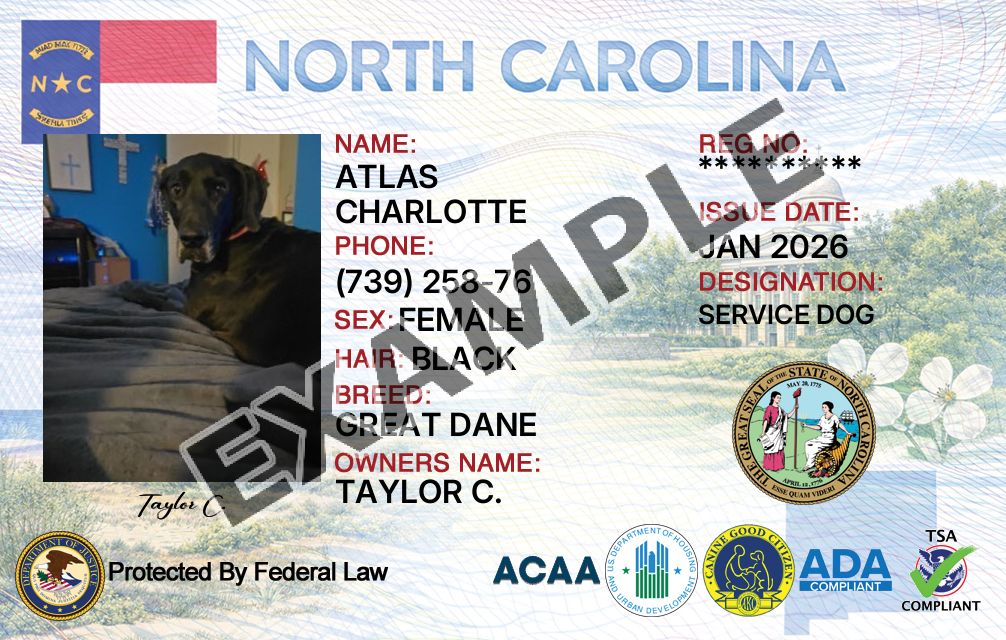
Service Dogs and Emotional Support Animals in Polk, North Carolina
If you’re searching where do I register my dog in Polk County, North Carolina for my service dog or emotional support dog, the answer is usually simpler than it sounds: in Polk County, “registration” is typically handled through the rabies vaccination and county license tag (sometimes called a rabies tag or license tag) issued and enforced locally through animal control.
In other words, getting a dog license in Polk County, North Carolina is generally about showing your dog has a current rabies vaccination and obtaining the appropriate county tag/record through the local program—while service dog legal status and emotional support animal (ESA) status are separate issues that are not created by a county “registration certificate.”
Where to Register or License Your Dog in Polk County, North Carolina
Licensing is often handled at the county level. Below are examples of official Polk County offices that are commonly involved in animal control enforcement, rabies compliance, and related licensing questions. If you’re unsure where to register a dog in Polk County, North Carolina, start with Animal Control through the Sheriff’s Office.
Official offices to contact
| Office | Address | Phone | Hours | |
|---|---|---|---|---|
| Polk County Sheriff’s Office (Animal Control) |
164 Government Complex Drive Columbus, NC 28722 |
828-894-3001 (option 3, then option 3)
Immediate assistance: 828-894-0187
|
Not listed publicly on the referenced pages | Mon–Fri, 8:00 AM–5:00 PM |
| Polk County Sheriff’s Office & Detention Center (Front Office) |
164 Government Complex Drive Columbus, NC 28722 |
828-894-3001
After hours: 828-894-0188
|
Not listed publicly on the referenced pages | Mon–Fri, 8:00 AM–5:00 PM |
| Polk County Sheriff’s Office (Mailing Address) |
164 Government Complex Drive Columbus, NC 28722 |
828-894-3001 | Not listed publicly on the referenced pages | Hours not listed for mail |
Note: Some older directories also list a Sheriff’s Office street address of 40 Ward Street, Columbus, NC 28722. If you’re trying to reach animal control dog license Polk County, North Carolina services, using the Sheriff’s Office main number above is the most direct starting point.
Quick call script (to save time)
When you call Animal Control, you can ask:
- “How do I get a current Polk County rabies license tag for my dog?”
- “Can I purchase the tag through my veterinarian, or do I need to come to the Sheriff’s Office Animal Control?”
- “What documents do you require (rabies certificate, proof of altered status, etc.)?”
- “If my dog is a service dog or ESA, does anything change for licensing/tag requirements?”
Overview of Dog Licensing in Polk County, North Carolina
What “licensing” usually means in Polk County
In Polk County, “licensing” commonly refers to the county’s rabies license tag program. County rules require dogs (and cats) of a certain age to be vaccinated against rabies, and owners are required to obtain a valid license tag as evidence of rabies vaccination. The tag is typically worn on a collar (or, in some cases, compliance may involve microchipping rules described by local ordinance).
Rabies vaccination requirements (North Carolina + local enforcement)
North Carolina law requires dogs, cats, and ferrets to be vaccinated against rabies and (for animals required to wear one) to wear a rabies vaccination tag. Locally, Polk County’s ordinance framework also ties rabies vaccination to the issuance of the county license tag and authorizes animal control enforcement actions when animals are not properly vaccinated/tagged.
Renewals and tag options (what to expect)
Polk County’s program describes options that can include a one-year renewal and a multi-year option associated with a qualifying three-year rabies vaccination. Fees may differ based on altered vs. unaltered status, and there can be late fees for renewals. Because fee schedules and procedures can change, confirm current pricing and renewal timing directly with the local office before you go.
How Dog Licensing Works Locally in Polk County, North Carolina
Step-by-step: where to register a dog in Polk County, North Carolina
- Get a current rabies vaccination from a licensed veterinarian (or attend an official local rabies clinic when offered).
- Keep your rabies certificate (the printed vaccination certificate is commonly required to obtain or renew a license tag).
- Purchase/obtain your county license tag through the local program. In Polk County, tags may be available either through participating veterinarians or directly through Animal Control (confirm the current process by phone).
- Attach the valid tag to your dog’s collar (or follow any alternate compliance method recognized by local rules).
- Renew before expiration so your tag remains valid and matches the rabies vaccination’s effective period.
Why licensing is handled locally (and why that matters)
The most important thing to understand is that most licensing is handled locally. Counties (and sometimes municipalities) administer rabies enforcement and tag programs because animal control operations, sheltering, and local public safety responses happen at the local level. That’s why the best answer to where do I register my dog in Polk County, North Carolina is: start with Polk County Sheriff’s Office Animal Control.
If you live inside a town (Tryon, Columbus, Saluda, Mill Spring)
Some pet-related rules (like leash requirements, nuisance rules, or local citations) can vary by municipality. Even so, the county rabies tag/licensing program and rabies enforcement are typically countywide. If you’re within town limits and receive conflicting guidance, ask Animal Control which rules apply at your address and whether the town has any additional requirements beyond the county license tag.
Service Dog Laws in Polk County, North Carolina
Service dog status is not created by a county “registration”
A common misconception is that you must “register” a service dog with the county. In general, service dog legal status comes from disability-rights laws and the dog’s trained work or tasks—not from buying a registration card or being listed in a database. Your county licensing tag is still important for rabies compliance, but it does not “make” the dog a service dog.
What you can do locally (practical steps)
- Keep your dog’s rabies vaccination and license tag current (this is often what local animal control will check first).
- Maintain training records (even though you usually don’t have to show “certification,” it helps you document legitimate task training).
- Consider an ID tag with your phone number (separate from the county tag). This can help with quick reunification if your dog is found.
Access questions: service dogs vs. pets
In most public-access situations, businesses may be allowed to ask limited questions about a service dog (for example, whether the dog is required because of a disability and what work or tasks the dog has been trained to perform). They generally should not require a vest, an ID card, or a “registration certificate” as proof. None of that replaces the separate requirement to follow local rabies and licensing rules.
Emotional Support Animal Rules in Polk County, North Carolina
An ESA is different from a service dog
An emotional support animal provides comfort by its presence, but it is not the same as a service dog trained to perform specific tasks. ESAs may be recognized in certain housing-related contexts, but they generally do not have the same broad public-access status as trained service dogs.
Does an ESA change dog license rules in Polk County?
Usually, no. Your ESA still needs to follow the same local animal control requirements as other dogs, including rabies vaccination and obtaining the appropriate county license tag when required. If you’re asking where do I register my dog in Polk County, North Carolina for my emotional support dog, the “registration” you’re most likely looking for is still the local rabies/license tag process handled through Animal Control and participating veterinarians.
Avoid third-party “ESA registration” claims
Be cautious of paid online services that promise instant ESA or service dog “registration.” For local compliance in Polk County, the key practical items are typically your rabies certificate and your dog license in Polk County, North Carolina (the county tag/record). For ESA housing situations, the relevant documentation is usually tied to your healthcare provider’s recommendation and applicable housing rules—not a purchased online certificate.
Frequently Asked Questions
In most cases, yes. A service dog may have public-access protections under disability laws, but local requirements like rabies vaccination and the county license tag can still apply. If you’re unsure, call Animal Control and ask whether any exemptions exist and what documentation is required for the local tag program.
Typically, you should expect to provide:
- Proof of current rabies vaccination (rabies certificate)
- Owner contact information
- Possibly proof of spay/neuter status (if fees differ by altered vs. unaltered)
In Polk County, license tags may be available through veterinarians that choose to sell them, or directly through the Polk County Sheriff’s Office Animal Control. Because not every vet necessarily participates, call ahead to confirm where you can purchase or renew your tag.
Generally, no. ESAs are not typically “registered” with the county in a way that creates ESA status. Local government programs are usually focused on rabies vaccination compliance and the county license tag. For housing-related ESA accommodations, documentation is usually handled through the housing process and appropriate professional support, not a county registry.
A visible tag is a quick way for animal control to confirm compliance and identify ownership if your dog gets loose. Not wearing a required tag can lead to enforcement actions depending on the situation. If you use a different compliance method (such as microchipping in certain contexts), confirm with Animal Control what is accepted and how officers verify compliance in the field.
Register A Dog In Other North Carolina Counties
Select your county below to get started with your dog’s ID card. Requirements and license designs may vary by county, so choose your location to see the correct options and complete your pup’s registration.
- Alamance County Dog Registration
- Alexander County Dog Registration
- Alleghany County Dog Registration
- Anson County Dog Registration
- Ashe County Dog Registration
- Avery County Dog Registration
- Beaufort County Dog Registration
- Bertie County Dog Registration
- Bladen County Dog Registration
- Brunswick County Dog Registration
- Buncombe County Dog Registration
- Burke County Dog Registration
- Cabarrus County Dog Registration
- Caldwell County Dog Registration
- Camden County Dog Registration
- Carteret County Dog Registration
- Caswell County Dog Registration
- Catawba County Dog Registration
- Chatham County Dog Registration
- Cherokee County Dog Registration
- Chowan County Dog Registration
- Clay County Dog Registration
- Cleveland County Dog Registration
- Columbus County Dog Registration
- Craven County Dog Registration
- Cumberland County Dog Registration
- Currituck County Dog Registration
- Dare County Dog Registration
- Davidson County Dog Registration
- Davie County Dog Registration
- Duplin County Dog Registration
- Edgecombe County Dog Registration
- Forsyth County Dog Registration
- Franklin County Dog Registration
- Gaston County Dog Registration
- Gates County Dog Registration
- Graham County Dog Registration
- Granville County Dog Registration
- Greene County Dog Registration
- Guilford County Dog Registration
- Halifax County Dog Registration
- Harnett County Dog Registration
- Haywood County Dog Registration
- Henderson County Dog Registration
- Hertford County Dog Registration
- Hoke County Dog Registration
- Hyde County Dog Registration
- Iredell County Dog Registration
- Jackson County Dog Registration
- Johnston County Dog Registration
- Jones County Dog Registration
- Lee County Dog Registration
- Lenoir County Dog Registration
- Lincoln County Dog Registration
- Macon County Dog Registration
- Madison County Dog Registration
- Martin County Dog Registration
- McDowell County Dog Registration
- Mecklenburg County Dog Registration
- Mitchell County Dog Registration
- Montgomery County Dog Registration
- Moore County Dog Registration
- Nash County Dog Registration
- New Hanover County Dog Registration
- Northampton County Dog Registration
- Onslow County Dog Registration
- Orange County Dog Registration
- Pamlico County Dog Registration
- Pasquotank County Dog Registration
- Pender County Dog Registration
- Perquimans County Dog Registration
- Person County Dog Registration
- Pitt County Dog Registration
- Randolph County Dog Registration
- Richmond County Dog Registration
- Robeson County Dog Registration
- Rockingham County Dog Registration
- Rowan County Dog Registration
- Rutherford County Dog Registration
- Sampson County Dog Registration
- Scotland County Dog Registration
- Stanly County Dog Registration
- Stokes County Dog Registration
- Surry County Dog Registration
- Swain County Dog Registration
- Transylvania County Dog Registration
- Tyrrell County Dog Registration
- Union County Dog Registration
- Vance County Dog Registration
- Wake County Dog Registration
- Warren County Dog Registration
- Washington County Dog Registration
- Watauga County Dog Registration
- Wayne County Dog Registration
- Wilkes County Dog Registration
- Wilson County Dog Registration
- Yadkin County Dog Registration
- Yancey County Dog Registration